
Pankhurst and Place
Local Places of Pilgrimage

On our Fall 2024 pilgrimage on the Way of St James in the UK, we discovered the resting place of John Snow who is buried in the grand Victorian Brompton Cemetery in London. We had finished our walking pilgrimage from Reading to Southampton and were taking a few rest-and-walk days in London when we wandered into this grand public cemetery which is currently managed by The Royal Parks. Finding Snow’s grave, a local pilgrimage site for those in the medical fields, completed the circle for my understanding the reason for the elegant Victorian public drinking fountain we encountered in Reading.
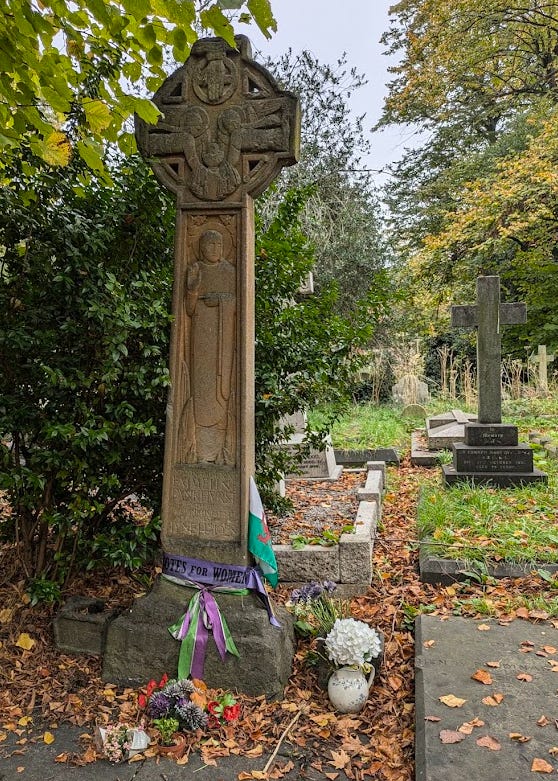
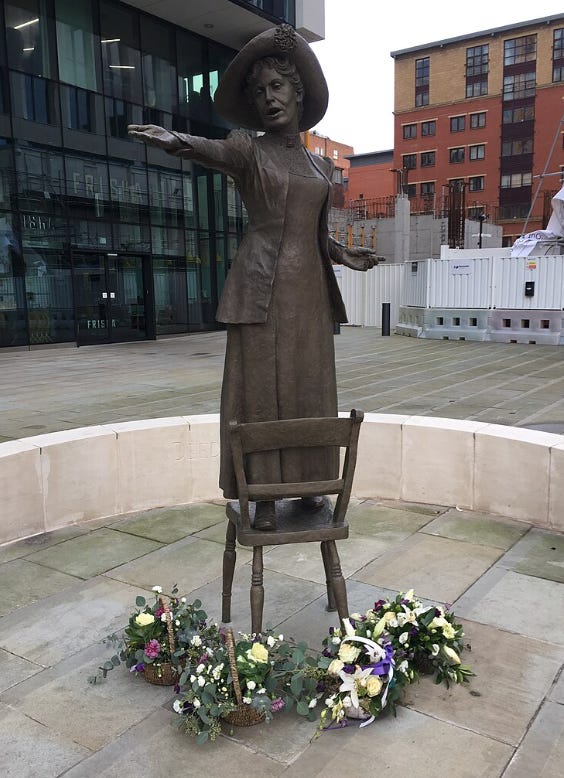
As we explored the cemetery further we discovered a wealth of local pilgrimage sites that included the resting place of Emiline Pankhurst, whose story I teach in my Feminist Political Ecology class at Goucher College. A newer statue in Manchester (the woman’s memorial installed in Manchester in a century!) has also become a local pilgrimage site, near the Pankhurst Centre, the former home of the Pankhurst family. Though Pankhurst is a globally important historical figure, the gravesite here melts into the beautiful natural setting of the rewilded cemetery, its Celtic cross rising tree-like within a setting that is part wildflower meadow and part woodland. Compared to the industrial setting of the newest tribute Pankhurst statue in Manchester, the gravesite is surrounded by renewed nature.
But there is another Pankhurst memorial with a different take on remembrance in London and that is on my list to visit when I return.
#/media/File:Statue_of_Emmeline_Pankhurst_-_December_2018_(3).jpg)
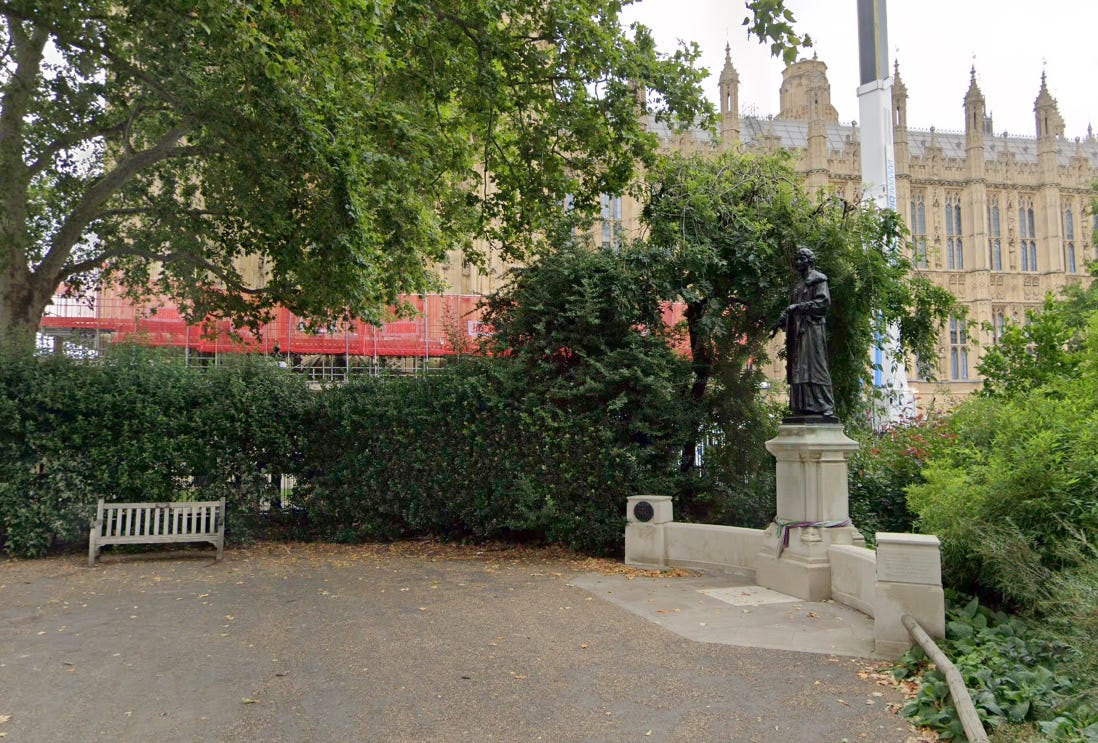
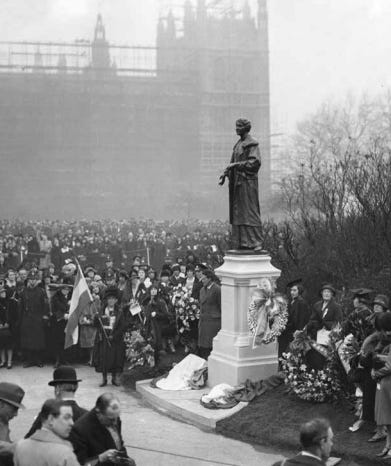
Shortly after Emiline Pankhurst’s death in 1928, a committee of fellow suffragettes (including suffragette daughter Christabell Pankhurst) organized to fund and manage how she would be memorialized. In addition to the Celtic gravestone we admired in the Brompton Cemetery, the committee lobbied and fundraised for a memorial to be placed near Parliament where so much of Pankhurst’s work took place. Their efforts resulted in the creation and 1930 installation of a memorial in the Victoria Tower Gardens, now an English Heritage site bounded by the Thames and The House of Lords. In 2018, the centennial year of movement’s winning the English women’s right to vote, a proposal was made to move the memorial to the private grounds at Regent’s University. A huge row ensued.
Elizabeth Crawford, a noted 20th century historian who has written many articles and books on the women’s suffrage movement wrote that if the Emiline Pankhurst Trust (chaired by the member of Parliament who made the proposal) “had wanted to erect a new statue to Mrs Pankhurst that did not involve casting the original aside as though it was of no consequence, I would have no objection. But I feel very strongly that we should honour the intention and actions of those who committed their time and money to setting Mrs Pankhurst in such an excellent position next to parliament”.
This is the crux of the argument against moving the memorial. The site selection of a memorial is often as important as the memorial itself. For a memorial to hold the most meaning, its physical placement within a landscape central to the work of the individual or movement is deliberate and critical to the story.
The argument was settled after a lengthy study and report was submitted that suggested the memorial not be moved. I read the whole thing so you wouldn’t have to but here it is in case you do. The report does contain key historical and archival information that, taken in the context of the proposal to move the monument, made it clear that this wasn’t such a great idea after all. To boot, an impressive collection of public comments against it also buried the proposal.
When my cousin Molly and I ducked into the Victoria Tower Gardens on our walk around Westminster, we had no idea of the recent drama that had played out in the far corner of the park. While we gawked at The Burgers of Calais by Rodin, the 1930 Pankhurst monument was hidden by shrubbery at our angle and so neither one of us saw it. But knowing that it is there still, in the very place the women of the suffragette movement decided it should go, lends a certain spatial sacredness to the memorial, a sacredness of place like that of the Brompton cemetery or the industrial-commercial center of working folk’s Manchester.
Landscape is central to the understanding of place of pilgrimage. Acts of remembrance and honoring, like draping green, purple, and white ribbons or placing white roses or chanting “Deeds not words!” at the commemoration event in St Peter’s Square in Manchester signify continuity of values or beliefs central to the reason for choosing the memorialized site. These are rituals found throughout the history of pilgrimage in the local landscape, the honorifics that blend historic memory in the dedicated space and place with relevance for the present.
Notes:
The Royal Parks maintains an informative website that highlights the persons buried in Brompton Cemetery, found here.
Elizabeth Crawford A Woman and Her Sphere Blog
Victoria Tower Gardens. Also a unit of The Royal Parks.
The Guardian. August 2018 “Anger over plan to move Pankhurst monument away from Parliament.”
The Guardian. December 2018. “Thousands welcome Emiline Pankhurst statue in Manchester.”
Donald Insall Associate’s Report on the Pankhurst Monument removal proposal (2018)
To think that we were on the "Emmaline Pankhurst Trail" in Reading and London, and didn't even realize it! Monuments have a way of being placed where people of the time think is a prominent location, only to have the tide of time change the course of the river of activity, to put the memorial in what becomes a backwater.